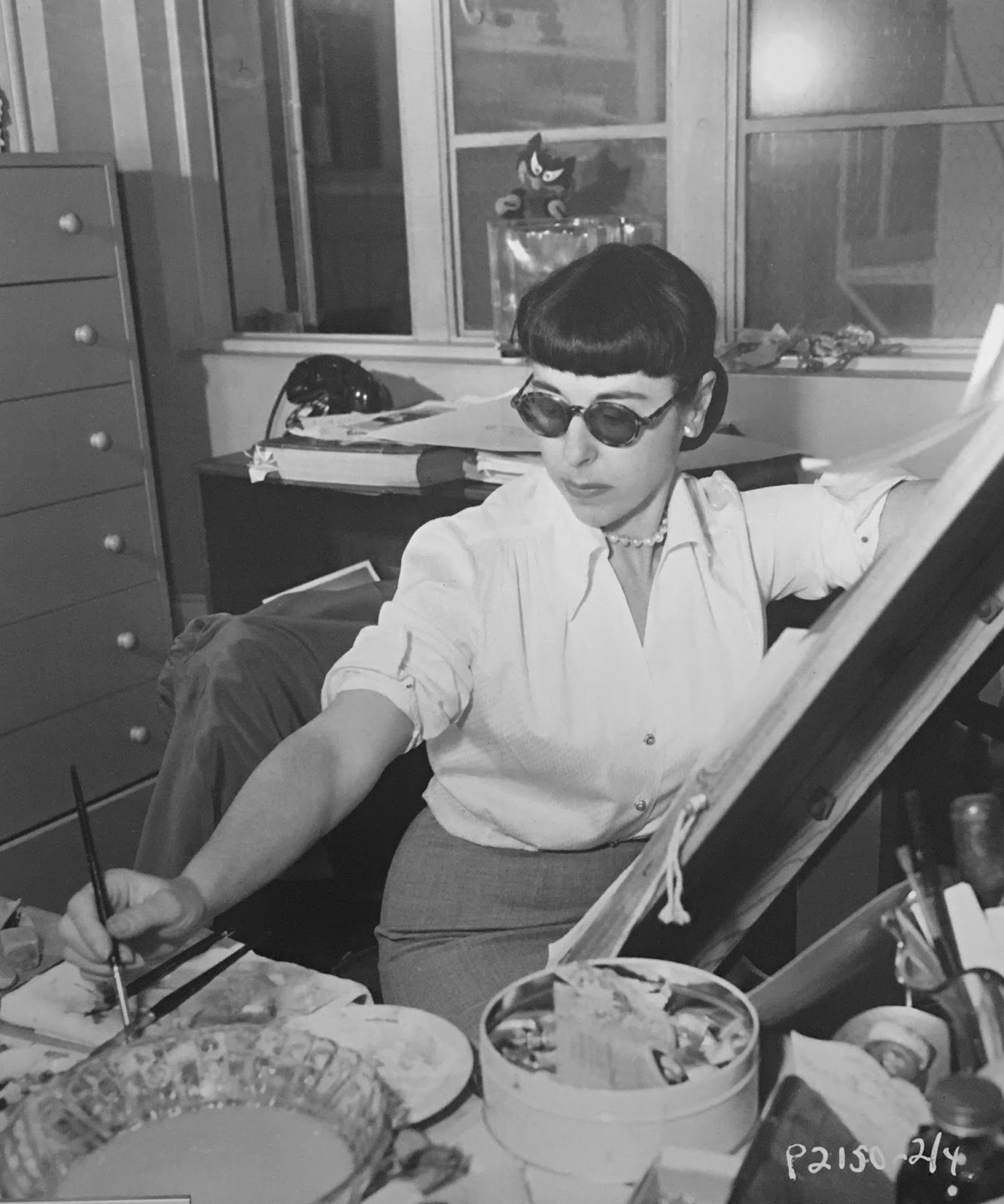
"Edith Head is considered the most significant costume designer in film history and today her name is synonymous with Hollywood costume of the twentieth century. Over her more than 50-year career in studio costume - first with Paramount Pictures and later with Universal Studios - Head worked with many of Hollywood's brightest stars on almost a thousand films."
BENDIGO ART GALLERY
-oOo-
Well after reading "no cameras" and thinking we wouldn't be allowed to take photos of the Edith Head exhibition, we found we were able to after all, as long as we didn't use a flash. So my dear daughter literally took hundred s of them (232 to be exact), however, I have selected just a few of my favourites to share.
Many of you were probably not even born when this two-piece wool suit was worn by Maureen O'Sullivan in
The Big Clock (Paramount Pictures 1948), but if you're a movie buff and fan of the silver screen you may be familiar with some of the following.
This silk ball gown was worn by Natalie Wood in Inside Daisy Clover (Warner Brothers 1965).
This two-piece silk performance costume by Betty Hutton in
The Perils of Pauline (Paramount Pictures 1947) is covered in Austrian crystal bugle beads . . . can you just imagine how many hours of work it would have taken to sew them all on. The back of this suit was stunning!
This silk evening gown worn by Caroll Baker in
Harlow (Paramount Pictures 1965) is also covered in thousands of Austrian bugle beads. Click on the photo to see a close view.
Adding embellishment to simple costumes was one of Edith Head's devices for creating instant glamour. Many of her simply cut and modest shape costumes were vastly improved and given a much more glamourous air by the inclusion of sequins and bugle beads.
The medieval-style cotton velvet costume worn by Shirley Temple in
Little Miss Marker (Paramount Pictures 1934) is beautifully embroidered. Shirley later wrote about her costumes for this film in her 1968 autobiography
Child Star.
"An exceptionally talented artist, she decided to make my costumes from scratch instead of drawn off the studio rack. This would require many try-ons while she created exactly the desired impression."
The peacock silk costume worn by Hedy Lamarr in
Samson and Delilah (produced and directed by Cecil B. DeMille and released by Paramount Pictures 1949) has the most beautiful beaded applique.
The peacock feathered cape accompanying the gown above, is without doubt one of the most recognisable elements of this costume and while the gown became part of the Paramount Pictures Archive, the cape has remained in the DeMille family. It is too fragile to travel, so unfortunately could not be reunited for this exhibition.
The hooded wool coat worn by Barbara Stanwyck in
The Strange Love of Martha Ivers (Paramount Pictures 1946) is shown with the black sweater and large gold chain she wore in the movie. I noticed that this style of chain was recently worn by Jayne Fonda on the Graham Norton Show, making it still very fashionable today.
I have been a long time admirer of Edith Head and her ability to design costumes for movies and although costuming may appear to be a glamorous profession, the work entailed is extremely demanding and time consuming. Especially when working on a period film, as all the costumes have to be thoroughly researched to ensure they accurately depict the garments worn at the time.
My daughter told me this exhibition had shown her a completely different aspect of film costuming which made her realise the amount of work that goes into each garment prior to the actual film's production.
Personally, I think Edith (above) deserved every one of the eight Oscars and twenty seven nominations she received during her fabulous career, and she still holds the record for the most awards won by a woman.
The final words belong to Edith Head:
"I would give this advice to every actress with whom I work, to every woman who will listen.
1. Be dressed for what you are doing.
2. Have the right accessories.
3. Don't wear your clothes too tight.
A dress should be tight enough to show you're a woman and loose enough to prove you're a lady.
I like that last. You can use that on my epitaph."
 . . . to design and make this little soul who is now living with a Swansea family, in the U.K.